
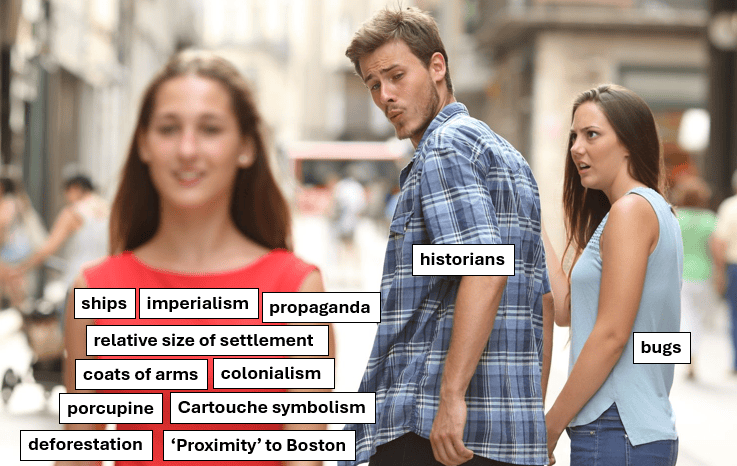
Maps are political. Maps are not neutral representations of geography! This objectivity expands beyond borders to the artistic embellishments found on many maps (especially maps from eras gone-by). We can learn about the past (values, fears, political leanings) by closely examining the symbols that were designed and featured. The 1750 “Porcupine Map” by Moses Harris, depicted Halifax Harbour in an effort that was intended to encourage British emigration to Nova Scotia. Compared to earlier regional maps, changes reflected in the Porcupine Map, such as removing depictions of Indigenous Mi’kmaq, and thinning the forests suggest efforts to make the colony feel more familiar to British readers of the time.
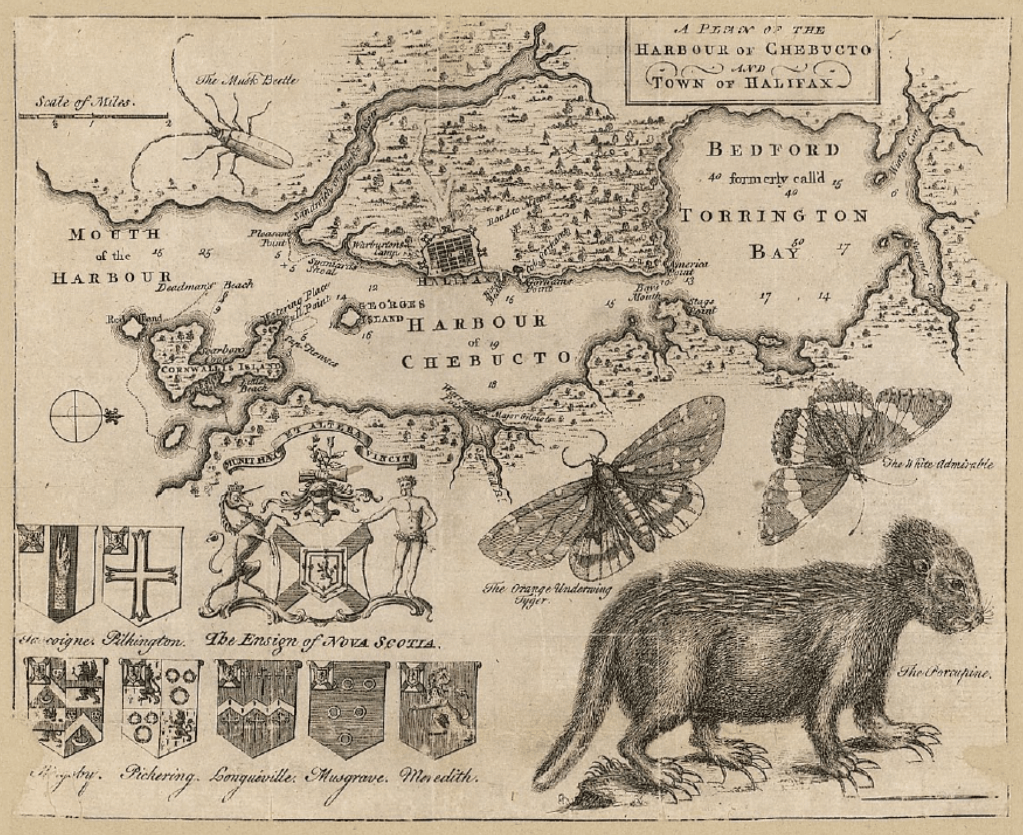
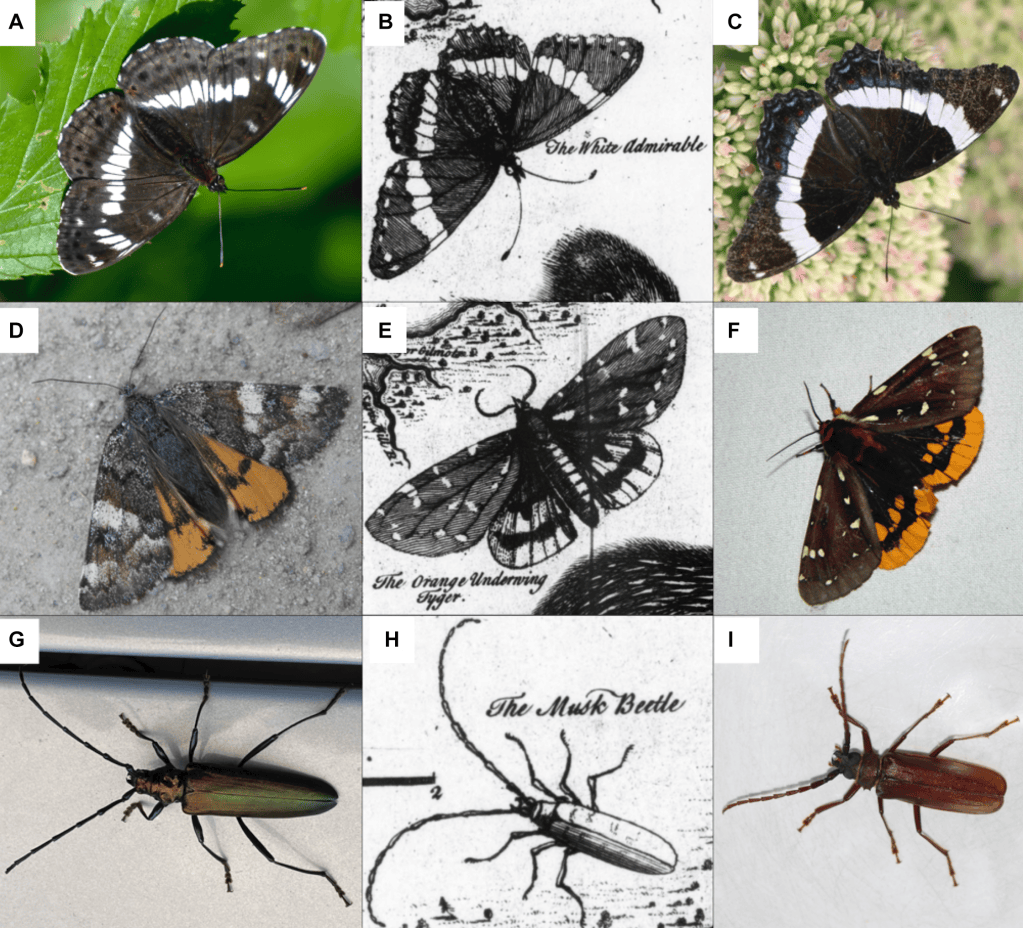
Although the titular porcupine illustration has received substantial interest, the map also features three prominent insects labelled as “The White Admirable,” “The Orange Underwing Tyger,” and “The Musk Beetle.” These common names refer to species occurring in Britain but not in Nova Scotia. These drawings are incredibly detailed – but have received comparatively scant scientific attention.
Together with colleagues Dr. Chris Cutler, and Dr. Robert France – we recently published a paper, that explored a little more about the man behind the map – and discussed the identity of these conspicuous, but largely under-appreciated insects. Two are clearly depicting different species (but are labelled as European species); the third species is not so clear. We argue that the inclusion of these detailed depictions of insects that are mislabelled as European species could represent: human error, artistic licence, or an overlooked expression of imperialistic propaganda. You can read the paper in its entirety (it’s open access) here.
This was a fun paper to write. As always – grateful for the constructive reviews, and the entire team at The Canadian Entomologist (especially Editorial Assistant – Monique Keiran) who was tremendously helpful throughout the publication process.
Reference:
Manning P, Cutler GC, France RL. First European depiction of insects from Canada: Moses Harris and the 1750 “Porcupine Map” of Halifax as a putative example of imperialism through entomology. The Canadian Entomologist. 2026;158:e22. doi:10.4039/tce.2026.10059
Post-note: Since publishing, we’ve heard from John Calhoun – who has done some really fantastic work on the history (natural and in the traditional sense) of Lepidoptera within the region. John reached the same conclusions with the identity of the insects (and three years earlier) in the wonderful Butterflies of Maine and the Canadian Maritime Provinces. Sorry to have missed this fabulous research John, and thanks so much for reaching out to share this with us!
Discover more from Insect Biodiversity in Agroecosystems Lab
Subscribe to get the latest posts sent to your email.
