
Many in our lab have a long-standing fascination with digital natural history records! These community-sourced natural history records are invaluable for understanding species attributes such as phenology and geographic distribution. When these records include photographs, they can also be mined for individual phenotype data and species interactions, allowing us to develop and test ecological hypotheses. We recently published a paper doing just that – this is how it went!
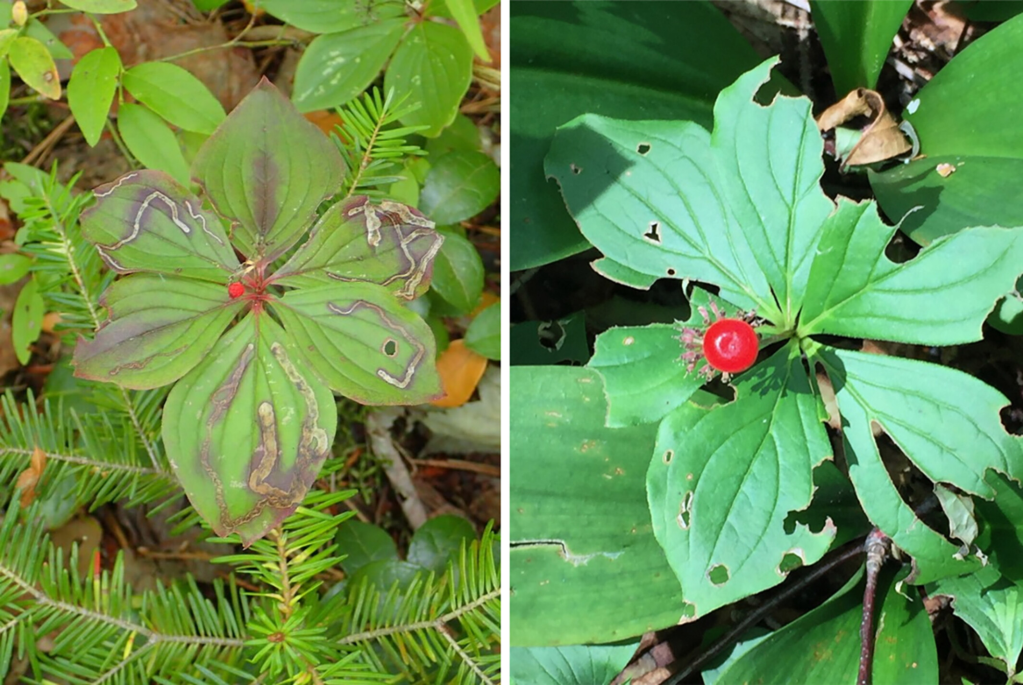
This project began as an applied research study in RESM3000 (Research Methods in Agriculture) that was spearheaded by Maria Duynisveld. The work combined observational and experimental approaches to assess how insect herbivory affects reproductive success in a widespread forest plant, bunchberry (Cornus canadensis). We queried the Global Biodiversity Information Facility (GBIF) and assembled a dataset of 2,578 photographic records of fruiting plants. Of these, 891 showed evidence of insect herbivory, but herbivory was not strongly associated with reductions in fruit production.
We then tried to validate this with field data. This part of the work happened well-after the class had ended, where superstars Maria and Rhydian jumped into action. Within a woodlot on Holdanca Farms, this duo monitored 200 plants over five weeks. Herbivory was widespread (78% of plants showed evidence of insect feeding), but damage was generally minimal—only 5% of plants experienced herbivory affecting ≥40% of total leaf area. Like with the GBIF data, no relationship was found between natural herbivory and fruit production.
In a second field study, Maria and Rhydian simulated high levels of herbivory by mechanically removing 40% of leaf area early and mid-season. Early-season herbivory reduced fruit production by 100%, while mid-season herbivory reduced fruit production by 87.3%. These results suggest that although severe herbivory early in the season can substantially reduce fruiting, the levels of herbivory most commonly observed in nature exert limited top-down control on reproduction in bunchberry.
By combining large-scale community-sourced records with controlled field experiments, this work demonstrates the value of mixed-methods approaches for testing ecological hypotheses and gaining insight into the processes that shape plant–insect interactions. I think this hybridized approach to experimentation has a tonne of value, and opens up some fascinating doors of new inquiry and discovery.
You can read the whole shebang open access (no paywall) over at Ecological Entomology. We can’t say enough good things about the careful reviews and editorial direction that our paper received. Would highly recommend sending any of your work within their realm to this wonderful society-owned journal. Huge kudos to Maria, Rhydian, and Bennie (who stepped in to lend their maths skills to working out the models) for all of their hard work! This work was so much fun to contribute to, and I am super proud of you all for your creativity and perseverance!
Reference: Duynisveld, M., Mildren, B., Crawford, R. & Manning, P. (2026) Does the munch affect the bunch? Using community science to explore insect herbivory and fruit production in an understory plant. Ecological Entomology, 1–12. Available from: https://doi.org/10.1111/een.70114
Discover more from Insect Biodiversity in Agroecosystems Lab
Subscribe to get the latest posts sent to your email.
