
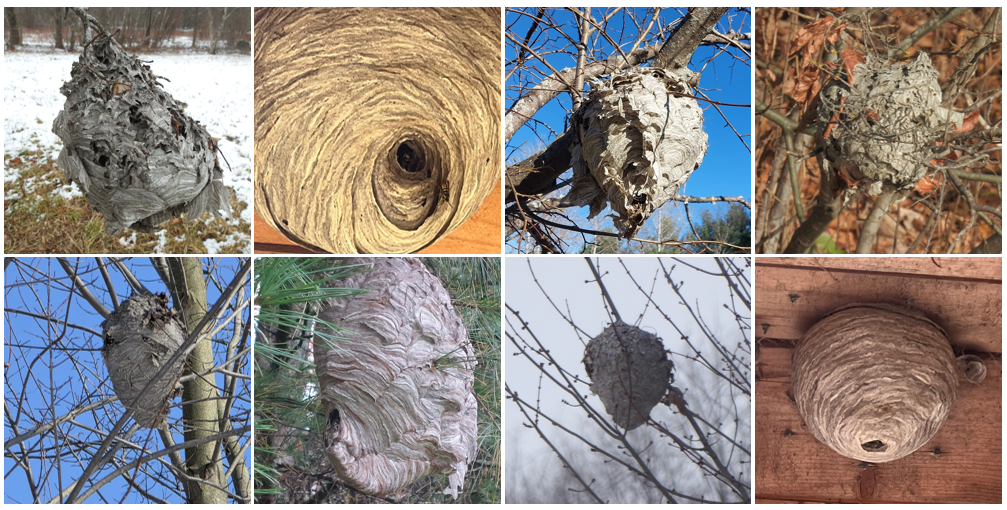
To indicate interest in contributing a nest to this project, please complete this form. Thanks for your interest and for supporting this work!
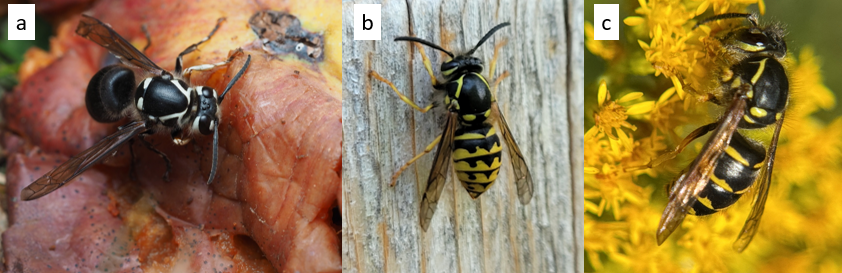
Urbanization is increasing globally and is associated with environmental changes that may
introduce and increase heavy metal contamination into terrestrial ecosystems. Lumber treated with wood-preservatives (e.g. chromated copper arsenate – CCA) is commonly used when building decks,
walkways, wharves, fencing, outdoor infrastructure and more. CCA-treated wood contains copper (Cu) and chromium (Cr), which can enter surrounding environments through weathering and material degradation, creating localized sources of heavy metal contamination.
We are investigating the potential of social wasp nests to detect this signature of human influence in the environment. Insects are widely used as biological indicators (bioindicators) because of their ecological sensitivity, abundance, and interactions with their environment. Social wasps (Hymenoptera:Vespidae) are particularly suitable due to their foraging behaviour and their habits of constructing nests.
In Eastern Canada, three aerial-nesting social wasps are particularly common: the common aerial yellowjacket (Dolichovespula arenaria), the bald-faced hornet (Dolichovespula maculata), and the northern aerial yellowjacket (Dolichovespula norvegicoides). In Dolichovespula spp. colonies, nests are created by the queens and sterile females, who forage for resources in a nearby radius to their nesting site. Females chew up plant fibres and weathered wood from surrounding environments and use a saliva-like secretion to create pulp in a process called maceration. They then regurgitate the pulp, which dries into nest paper. During nest building, environmental materials are incorporated into the nest potentially allowing contaminants such as heavy metals present in local environments to accumulate within the nest’s paper.
These social wasp species occur across both rural and urban landscapes and are frequently found nesting near buildings and treated wood surfaces, suggesting their nests may reflect localized environmental exposure associated with urbanization.
For this study, we are seeking nests from different areas around the province of Nova Scotia. We will test for the presence of copper and chromium using Flame Atomic Absorption Spectroscopy (Flame AAS). Flame AAS is an analytical technique commonly used to quantify trace metal concentrations in biological and environmental samples. In this method, samples (paper) are first chemically digested using acid digestion to dissolve solid material and release metals into solution. The digested sample is then aspirated into a flame, where atoms are vaporized and absorb light at element- specific wavelengths; the amount of light absorbed is proportional to the concentration of the target metal.
If wasps are foraging wood fibres from a wide variety of wooden surfaces, and the prevalence of CCA-treated wood is higher in urban areas – we should expect to see higher concentrations of copper and chromium in wasp nests from more urbanized areas. Alternatively, if wasps are preferentially seeking out treated wood for nest construction – we might see similar levels of metals in urban and rural areas.
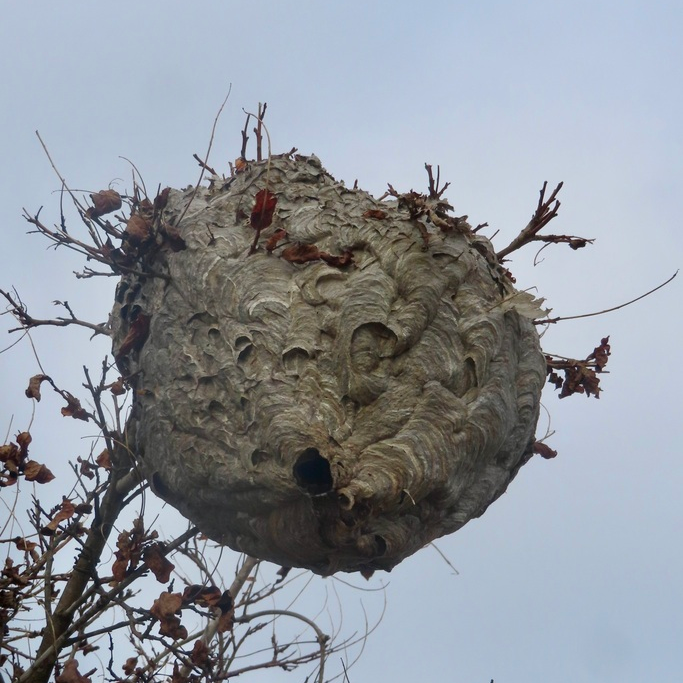
If you see a nest like the one above during the winter months (December-April), the wasps inside will have been killed by the winter temperatures. Mated queens will be hiding out in a cozy spot (but not inside the nest): often under tree bark, in a rotted out log, woodpiles, rock crevices, or in the leaf litter. Nests normally get ripped into shreds over the winter by high winds, and animals looking to snack on whatever dead workers might be remaining inside.
If you have a nest on your property that you’d like to contribute to science, please fill out the form below. We are collecting nests between now and early May. It is okay if they’re a little worse for wear – tattered is the norm for this time of year. We will keep you up-to-date with what we find as part of this work. This research will form the basis of the undergraduate thesis of Carlie Ashton – a BSc Environmental Science student at Dalhousie University – Faculty of Agriculture.
To indicate interest in contributing a nest to this project, please complete this form. Thanks for your interest and for supporting this work!
