
You can find the whole article available for free when it is marked “open access”. For full-text access to any of the other publications, I can send you an authors copy. You can write to me via e-mail or connect with me on Research Gate. Though I endeavor to keep this list of publications up-to-date regularly, you can find a very current list of laboratory publications on my Google Scholar page.
| Title | Main Findings | ||
| Knowledge of an insect pest negatively affects sensory perception and emotional response to blueberries Read the paper here. | The blueberry maggot is an insect pest that develops in ripening blueberries. We explored how sharing information about the blueberry maggot before tasting berries affected sensory evaluation of blueberries. Maggot-informed (MI) participants were less likely to report positive emotions after consuming blueberries. MI participants were less likely to rate samples as sweet, purple, juicy and fruity. Our results show that knowledge of an insect pest can negatively affect how we taste and perceive food. This study reaffirms the low tolerance of consumers towards insects in fresh fruit, thus demonstrating the importance of effective pest control. | ||
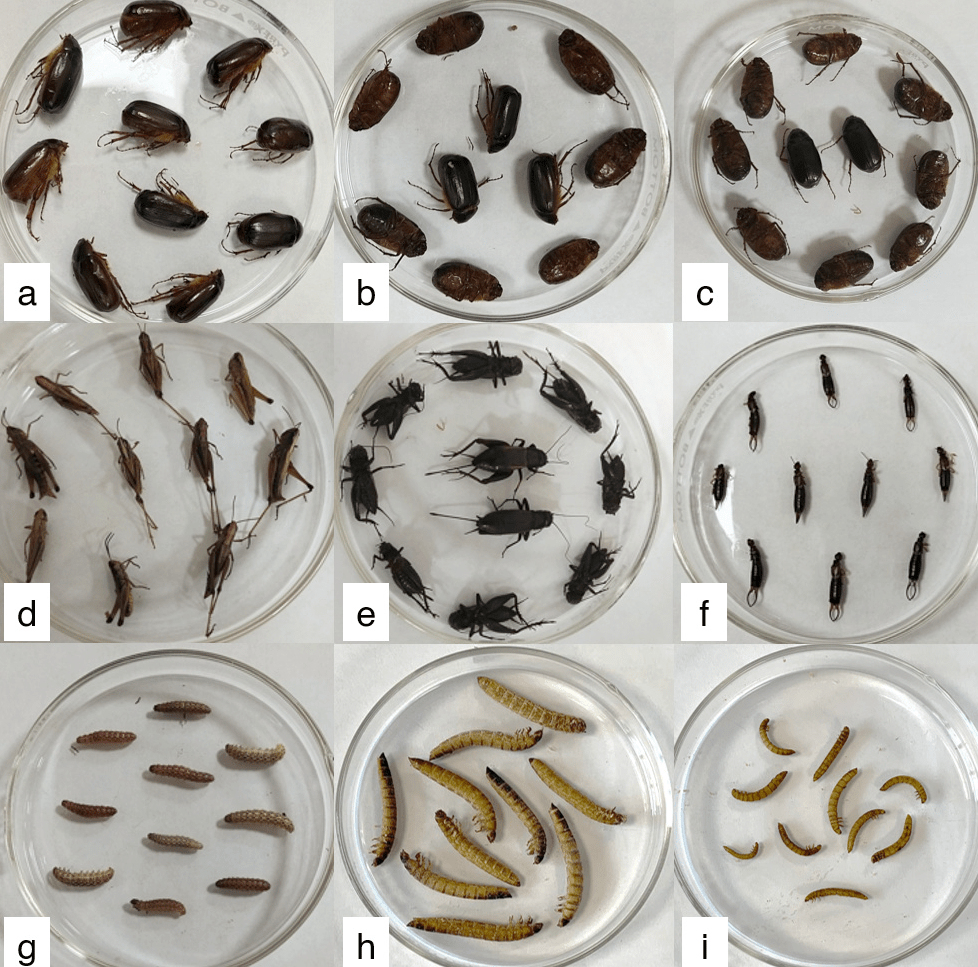
| The nutritional composition of common wild-harvested insects in the Canadian province of Nova Scotia Read the open access paper here. | Insects are widely consumed as food across much of the world. More than 97% of these species are wild-harvested. In this paper, we measured the nutritional properties of some common and abundant insects found in the Canadian Province of Nova Scotia. We found that wild-caught insects had comparable nutritional profiles to commercially-reared insects. We also discuss some of the challenges and limitations to consuming insects harvested from the wild. | ||
| Conserving insect biodiversity in agroecosystems is essential for sustainable diets (2022) Read the chapter here | This textbook chapter talks about the importance of maintaining insect biodiversity in agroecosystems for sustainable human diets. The paper uses three case studies: -Environmental sustainability via case of dung beetles -Social sustainability through human-bee relationships, and -Economic sustainability through discussion of pest control through natural enemies. We conclude that many conventional agricultural practices threaten insect biodiversity; and are not well aligned with sustainable diets, and suggest strategies that can improve | ||
Does sending honey bee (Apis mellifera) colonies to lowbush blueberry pollination increase severity of Nosema sporeloads? (2022) Read the paper here [open access] *This research was based on an undergraduate thesis completed by Jillian Shaw! Congratulations Jill! | We used a community science approach to explore how sending bees for lowbush blueberry pollination affected the sporeload of a bee pathogen: Nosema spp. Our study determined: Supplemental feeding with pollen patties increases Nosema infestations in A. mellifera. Sending bees to blueberry pollination does not increase intensity of Nosema infections. Nosema apis has been largely replaced in Maritime Canada by Nosema ceranae. | ||
| Exploring the value of a BioBlitz as a biodiversity education tool in a post-secondary environment (2021) Read the paper here | We used an online survey to gauge how students responded to an interactive inquiry-based “bioblitz” across two university campuses. More than 80% of students agreed that the BioBlitz provided a valuable hands-on learning opportunity. Students valued learning outside of a traditional classroom, and felt they learned new knowledge about species identification. Many students reported a heightened sense of environmental stewardship and a positive sense of place on campus as a result of their participation. | ||
| Using citizen science to explore the spatial distribution of the daylily gall midge (Contarinia quinquenotata) in Maritime Canada (2021) Read the paper here [open access] *This research was based on an undergraduate thesis completed by Alicia Cattiaux! Congratulations Alicia! | We used a combination of survey data, a common garden experiment, and molecular biology to determine whether an invasive pest of daylilies was established in Atlantic Canada. We found: The daylily gall midge occurred widely across Nova Scotia, and was spotted as early as 2018. Selecting early-blooming and yellow varieties can help reduce the impact of this pest. This pest moves through soil, and we highly recommend gardeners only buy/sell/share bare-root plants to mitigate further spread. | ||
| Fenced community gardens effectively mitigate the negative impacts of white-tailed deer on household food security Read the paper here [open access] | White-tailed deer are large herbivores that thrive in urban and peri-urban landscapes. Their voracious appetite and ubiquity have made deer a significant threat to growing food in home and community gardens; features that often make important contributions towards household food security. Focusing on food availability, stability, utilization, and access, I outline how white-tailed deer threaten household food security. I argue that fenced community gardens can be an effective solution to avoiding many of the problems that white-tailed deer pose to household food security. | ||
| Dung beetles: indicators and supporters of ecosystem health. Read the paper here [open access] | Dung beetles are found across the world; not just in tropical ecosystems. Through burying the dung of animals, they play many roles in keeping our environment healthy. This article was written for “Frontiers for Young Minds”, a peer-reviewed journal that is targeted towards youth, to connect young minds with experts in the field. This was a very enjoyable article to write with an excellent team (Xin Rui Ong & Eleanore Slade), and the illustrations by a graphic designer are top notch! Please share this article with young people in your life, who might be interested in learning more about the wonderful world of dung beetles! | ||
| Exposure to low concentrations of pesticide stimulates ecological functioning in the dung beetle Onthophagus nuchicornis Read the paper here [open access] | In this article, we explored how body-size affected the ability of different size classes of beetles (large and small) to withstand exposure to pesticides, and bury dung. We found that there was no difference in larger vs. smaller beetles in explaining their ability to withstand pesticide exposure. Larger beetles were more functionally effiecient than smaller beetles (they buried heavier dung parcels in larger quantities). We also found that a low level exposure to the pesticide ivermectin, caused beetles to bury more dung! This was the first recognized incidence of hormesis in a dung beetle. | ||
| Ivermectin residues in cattle dung impair insect‐mediated dung removal but not organic matter decomposition Read the full paper here. *This research was based on an undergraduate thesis completed by Bernadette Kavanaugh! Congratulations Bernadette! | We used an innovative field-based method to affect what kind of insects would colonize cow dung. We then asked how the presence of low levels of the pesticide ivermectin affected decomposition provided by insects. We found: First study (that we know of) to attempt to separate and quantify the ecological importance of beetles from flies. Ivermectin somewhat affected dung burial by beetles, and beetles + flies. Organic matter decomposition was unaffected by the presence of ivermectin. | ||
| Forest cover enhances natural enemy diversity and biological control services in Brazilian sun coffee plantations Read the full paper here | Many insects provide important ecosystem services to agriculture. In sun coffee plantations, predatory wasps play an important role in controlling the population density of coffee leaf miners. Through measuring the diversity and abundance of wasps, and quantifying pest control efforts, this work found: The abundance of an insect group may be more important than the diversity of an insect group in providing ecosystem services. Ecosystem services provided by insects can be more related to the management of the wider landscape than local management factors. | ||
Effects of replanting and retention of mature oil palm riparian buffers on ecosystem functioning in oil palm plantations Read the full paper here | Oil palm plantations are a major agricultural land use throughout much of Southeast Asia. In the coming decades large areas of mature oil palm will be deemed “unproductive” and will be cleared and replanted. To inform more sustainable long-term production in this globally important crop, it is crucial we understand how replanting impacts ecosystem functions and services. We determined how numerous production-relevant ecosystems functions (dung removal, soil mesofauna feeding activity, herbivory, herbivore predation, and seed predation), and the simultaneous delivery of all functions (ecosystem multifunctionality), varied between recently-replanted oil palm (1–4 years) and mature oil palm (23–30 years). We found that all ecosystem functions (except herbivory) did not differ between recently-planted and mature oil palm. | ||
You can find the whole article available for free when it is marked “open access”. For full-text access to any of the other publications, I can send you an authors copy. You can write to me via e-mail or connect with me on Research Gate. Though I endeavor to keep this list of publications up-to-date regularly, you can find a very current list of laboratory publications on my Google Scholar page.
 Insect Biodiversity in Agroecosystems Lab