
Here at the Insect Biodiversity in Agroecosystems Lab – we’re big believers in better understanding the power of insects to shape and support healthy ecosystems.
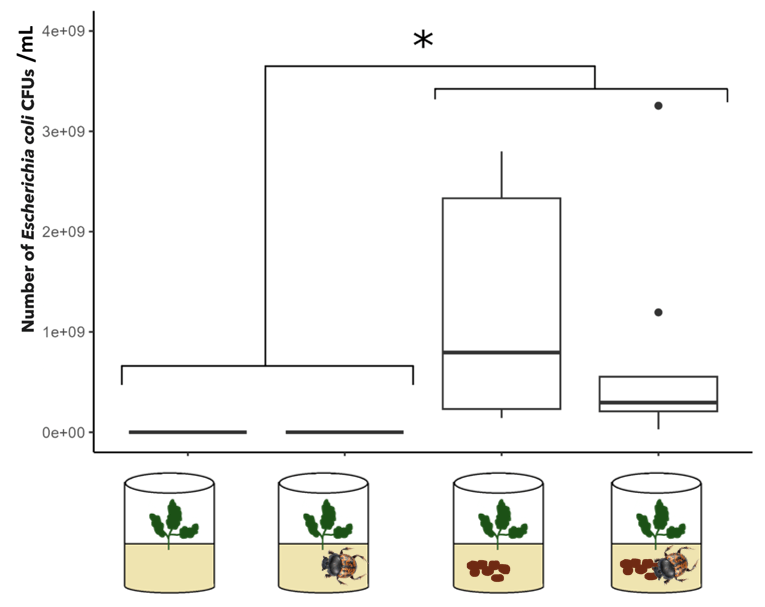
In the summer of 2024, undergraduate student saran Jayaselvam developed a research project to better understand how E.coli shed by wildlife (white-tailed deer) might impact the safety of leafy greens. Foodborne illness outbreaks are a significant public health challenge, and an important source of outbreaks is wildlife feces. Using a laboratory study, we investigated the potential of a common dung beetle (Onthophagus nuchicornis) to mitigate E. coli transfer from white-tailed deer (Odocoileus virginianus) feces to kale plants. We found that when mesocosms contained deer feces, splash-mediated contamination resulted in E. coli transfer to kale. Although dung beetles buried large volumes amounts of deer feces, their presence did not substantially lower E. coli levels on kale leaves.
You can read more about this work in Applied Soil Ecology – it’s open access!
 Insect Biodiversity in Agroecosystems Lab